
Consistent by Design: Engineering GenAI Applications for Repeatable Output
The model is probabilistic. The application does not have to be.

← Part 1: Locked In Without Knowing It: Why Swapping AI Models Breaks More Than You Think covered behavioral lock-in at the organizational level.
TL;DR The previous article established the problem: GenAI applications are behaviorally coupled to the models they are built on, and that coupling makes model changes expensive, unpredictable, and organizationally risky. This article addresses the engineering response — specifically the runtime layer. The model is probabilistic, but the application does not have to behave as if it is. Consistent, repeatable output within defined thresholds is an engineering achievement, not a property of the model. It is achieved by minimizing the probabilistic surface area of the application: grounding the model in authoritative references it must be faithful to, constraining its output space through typed schemas, wrapping the model call in deterministic logic, drawing a clear boundary between what belongs to the model and what belongs to the application, and using prompting as the instruction layer that ties these elements together. This article covers each element and closes with what this looks like at enterprise scale.
Every GenAI application ships with a hidden assumption: that the model will behave consistently enough for the application to be reliable. That assumption is not wrong — it is just untested. Nothing in the system is built to make it true. Foundation models are probabilistic systems. The same input produces different outputs on successive calls. Temperature, sampling parameters, model version, system prompt context, and tool availability all shift the output distribution. Left unaddressed, this flows directly into the application layer. Outputs vary. Downstream systems break intermittently. Users experience inconsistency that cannot be traced to a code change because it did not come from one.
The engineering goal is not to make the model deterministic — that is not possible and not the target. The goal is to minimize the probabilistic surface area of the application: to constrain the model’s degrees of freedom so that its outputs reliably fall within a defined behavioral envelope, regardless of which run, which session, or which day the call is made. That is a solvable engineering problem. The instinctive response is better prompting. Prompting is part of it, but prompting alone is not the solution — a prompt is an instruction set, not a reference. The model interprets it probabilistically on every call. Consistency requires anchoring, not just instructing.
The diagram below captures this in outline — five layers, each progressively narrowing the model’s output distribution toward the behavioral envelope the application has defined.
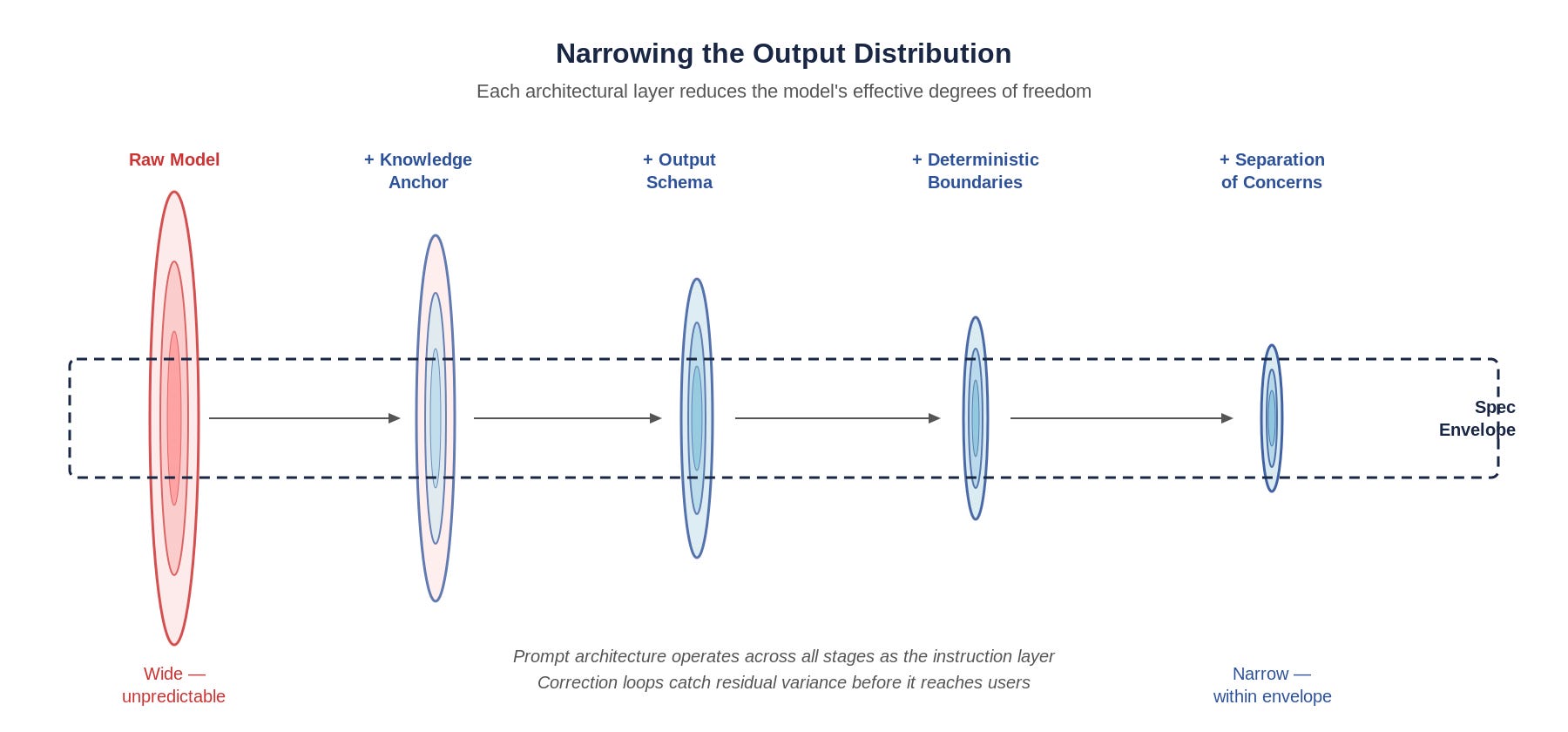
Figure 1: Five architectural layers progressively constrain the model’s output distribution toward the behavioral envelope defined by the spec.
The Behavioral Specification: Knowing What the Envelope Is
Anchoring requires a target. Before runtime architecture can be meaningful, the application needs a precise definition of acceptable behavior that exists independently of the model producing it. Without this, there is no engineering target — only a baseline derived from what the current model happens to produce, which is a description, not a standard.
A behavioral specification defines that standard in two layers. Non-negotiables are the behaviors that must hold universally, with zero tolerance for violation, precisely defined and enforced as pass/fail tests. Behavioral properties define what the application must do reliably, expressed as conformance thresholds over a sample — not guarantees on every call, but defined and testable envelopes. The threshold for each property is set based on what downstream systems and users can tolerate, not based on what the current model produces.
Behavioral properties defined in the abstract are not yet testable. “Responses scope to the question asked” or “tone matches the established voice” are useful definitions — but only if you can evaluate them. That requires ground truth: a corpus of verified, known-correct outputs that represent what conforming behavior actually looks like for this application. Ground truth is built before deployment, through human review of representative outputs against the behavioral properties defined in the spec. Subject matter experts evaluate and annotate outputs as conforming or non-conforming; that annotated corpus becomes the calibration reference the validation layer uses at runtime. This is deliberate work, and it produces a versioned artifact that has to evolve as the specification does. Without it, behavioral properties are descriptions, not tests. How the corpus is governed, kept current as the spec evolves, and what happens when a violation reaches production despite the runtime layer — those are verification-layer concerns addressed in the next article.
The specification is the engineering target. Everything in the runtime architecture below is building toward it. The verification layer — covered in the next article — is how you confirm you hit it and keep hitting it when the model changes.
The Runtime Architecture: Minimizing Probabilistic Surface Area
The path to consistent output is not better prompting. It is better architecture — specifically, an architecture that reduces the model’s degrees of freedom at every layer so that the space of outputs it can produce is narrower than the space of outputs the application can tolerate. Five elements achieve this: knowledge anchoring, output schema and type enforcement, deterministic processing boundaries, separation of concerns, and feedback and correction loops. Prompt architecture is the sixth — the instruction layer through which all five are coordinated at call time. Each is addressed in turn.
Knowledge anchoring
A prompt tells the model what to do. It does not give the model something authoritative to be faithful to. The model interprets instructions probabilistically, drawing on parametric knowledge that varies in reliability across domains and may conflict with the application’s requirements. Knowledge anchoring replaces “behave consistently” — an instruction — with “be faithful to this” — a reference. Retrieval-augmented architectures, document-grounded response patterns, and structured knowledge bases bring authoritative material into the model’s context at call time. The model is not asked to recall or reason from general knowledge; it is constrained to be faithful to what is present. Consistency comes from the anchor, not from the instruction to be consistent.
Critically, the knowledge anchor does not only operate at the start of the pipeline. It travels through the entire workflow. At output validation, faithfulness to the anchor is checked alongside behavioral property conformance — a response can pass structural checks and still misrepresent or contradict the source material, which the anchor check catches. Within correction loops, when the model evaluates its own output before returning it, the anchor is the reference it checks against: not just “does this meet the format requirement” but “does this reflect what the source material actually says.” Across session turns, the anchor ensures that each response in a conversation remains grounded to the same authoritative reference, not just internally coherent. The anchor is not an input to the model call. It is the reference the entire pipeline is accountable to.
Ground truth is a related but distinct concept. The knowledge anchor is a content reference — it constrains what the model draws from at generation time. Ground truth is a behavioral reference — it captures what correct outputs look like, independent of what they are about. A model swap that leaves the anchor intact can still shift the behavioral profile in ways only ground truth will catch.
One thing knowledge anchoring does not resolve: it relocates the trust problem rather than eliminating it. The anchor is only as reliable as the source it draws from — an authoritative source with errors produces faithfully wrong outputs: grounded, schema-conforming, and incorrect. Retrieval quality compounds this: poor retrieval delivers a poor anchor at call time, and downstream checks validate faithfulness to what was retrieved, not accuracy against reality. High-quality, well-maintained knowledge sources are a prerequisite for anchoring to work.
Output schema and type enforcement
Where downstream systems require specific output formats — structured JSON, typed decisions, categorized classifications — the model’s output space can be architecturally constrained rather than validated after the fact. Modern model APIs support JSON schema enforcement, constrained decoding, and function-calling interfaces that force outputs into defined structures. This eliminates format variance by design: the model cannot produce unstructured prose where a typed object is required, and it cannot omit required fields or return an unexpected structure.
What schema enforcement does not solve is content consistency. A schema-conforming output can still contain wrong, hallucinated, or inconsistent content. A field defined as “citation” passes validation regardless of whether the citation traces to a real source. A field defined as “risk_assessment” passes regardless of whether the assessment is faithful to the underlying document. Schema enforcement makes the inconsistency structurally tidy — it does not eliminate it. Its real contribution is as a complement to knowledge anchoring: the schema defines what fields must be populated and in what form; the anchor constrains what can legitimately go into those fields. Together they address both the structural and content dimensions of consistency. Applied without the anchor, schema enforcement solves the easier problem while leaving the harder one untouched.
Deterministic processing boundaries
The probabilistic model call is one step in a larger workflow. The goal is to make that step as small as possible — to push as much logic as can be expressed deterministically into the application layer and leave the model responsible only for what the model must do. Input normalization, context assembly, knowledge retrieval, output parsing, business rule application, routing logic — all of this belongs in deterministic code, not in the model call. An application where the model is making decisions that could be expressed as code is an application that has transferred unnecessary behavioral variance to the model. The narrower the model’s responsibility, the more consistent its output will be, because the space of relevant inputs is smaller and better defined.
Separation of concerns
Deterministic processing is about removing logic that does not belong in the model call. Separation of concerns is about why that boundary must be drawn explicitly: the most common source of behavioral inconsistency in GenAI applications is not model variance — it is an unclear boundary between what belongs to the model and what belongs to the application. When the model is asked to make decisions it should not own — routing, business logic, policy enforcement, state management — the application becomes dependent on the model’s interpretation of those decisions, which varies. Drawing the boundary explicitly and enforcing it architecturally reduces the model’s effective decision space to what only the model can do: language understanding, generation, and reasoning over retrieved content. Everything else is application logic.
Feedback and correction loops
Within a single call, multi-step reasoning patterns — where the model checks its own output against defined criteria before returning a response — reduce the rate of non-conforming outputs reaching the validation layer. Across calls, session state and consistency checks ensure that the model’s outputs within a session remain coherent with prior outputs. A response that contradicts an earlier characterization in the same session is a consistency failure that session-level checks can catch and correct.
Correction loops draw on two distinct references when prompting the model to evaluate its output. The knowledge anchor handles content faithfulness — does this response reflect what the source material actually says? Ground truth handles behavioral conformance — does this output match the behavioral pattern the application requires? Both checks belong in the correction loop. A response can be anchor-faithful and still fail behavioral conformance: factually grounded but structured incorrectly, scoped too broadly, or expressed in a voice that does not match the established pattern. The correction loop that only checks one leaves the other unchecked.
Self-evaluation has a known failure mode: the model tends to confirm its own outputs rather than genuinely challenge them. Correction loop prompts need to be structured to interrogate rather than review — presenting the output alongside the anchor and asking specifically where it departs from the source material, rather than whether it is correct overall. The question “Is this response accurate?” is much weaker than “Which claims in this response are not directly supported by the retrieved material?” The structure of the correction prompt is as important as the fact of having one.
Prompt architecture
Prompting is the instruction layer through which all of the above is coordinated. A well-architected prompt defines the output format, establishes the operating scope, names the non-negotiables, and provides the model with the grounded context retrieved for this call. It is not the mechanism that produces consistency — the elements above produce consistency. The prompt is what communicates the boundaries and the reference material to the model at call time. It needs to be treated as a first-class engineering artifact: versioned, reviewed, and governed with the same rigor as application code. A system prompt that drifts informally across iterations is a behavioral specification change. It needs to be treated as one.
What This Looks Like at Runtime
The diagram below shows how these elements compose into a pipeline — each stage reducing the space of outputs before it reaches the next.
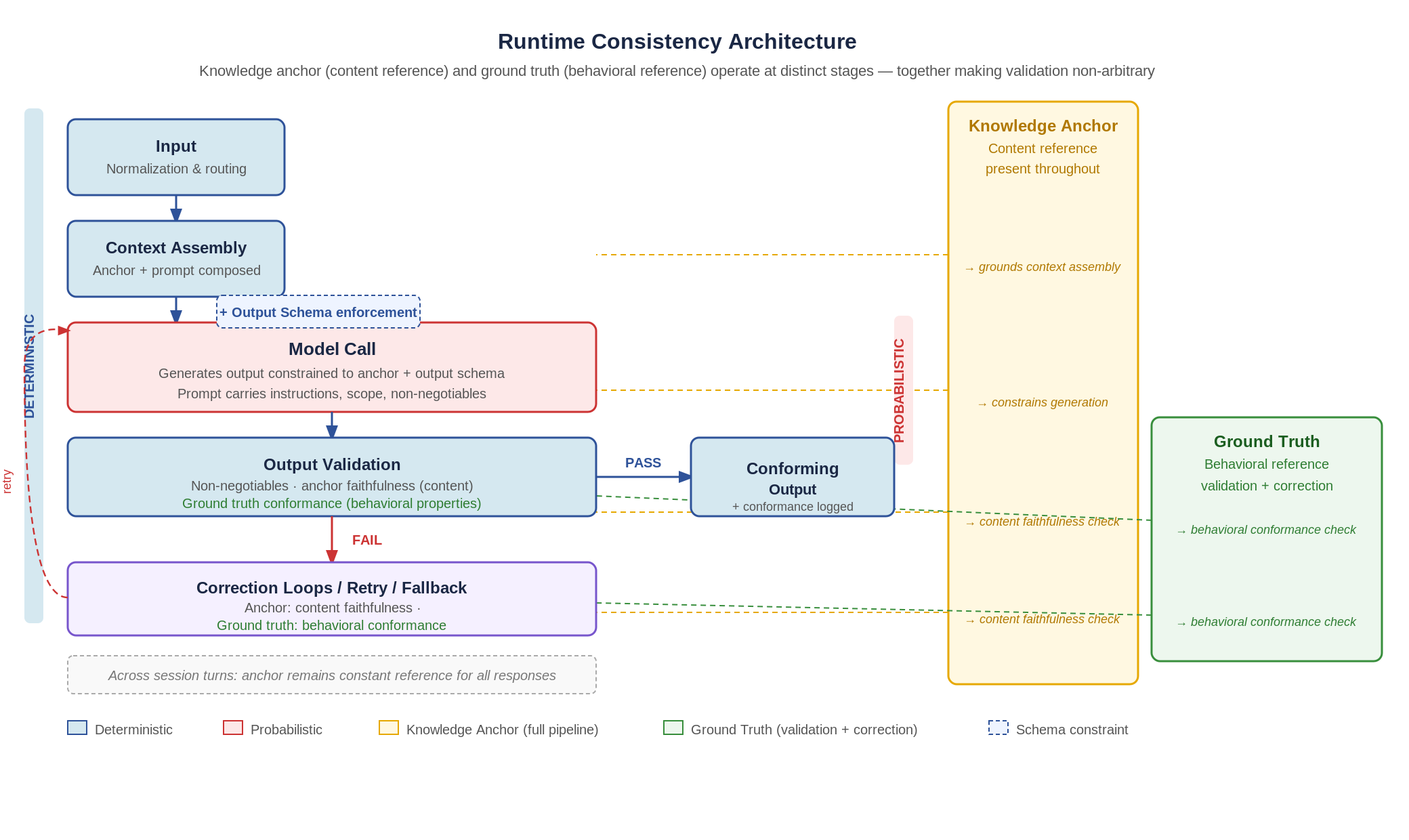
Figure 2: Runtime architecture showing the knowledge anchor as a continuous reference across context assembly, model call, output validation, and correction loops.
These elements are not independent choices — they compose into a runtime architecture where the probabilistic surface area is deliberately minimized at each stage. A call enters the system, passes through deterministic pre-processing and context assembly, retrieves grounding material from an authoritative source, reaches the model with a well-defined prompt and a constrained output schema, passes through output validation before the response is returned, and triggers retry or fallback logic if validation fails. The non-deterministic step — the model call itself — operates on a precisely prepared input and is constrained to return a typed, validated output. The variance that remains is variance within the behavioral envelope the specification defines as acceptable.
Output validation operates against two references simultaneously. Non-negotiable checks are deterministic: required fields present, schema correct, prohibited content absent. Behavioral property checks require calibrated judgment: is this response appropriately scoped? does the tone conform? is the completeness level correct? Those checks are calibrated against the ground truth corpus — the annotated examples of conforming and non-conforming outputs built during specification. For simpler behavioral properties, a direct similarity check against ground truth examples may be sufficient. For more complex judgment, a judge model is used, calibrated against the ground truth corpus rather than queried on every call. Either way, it is the ground truth that makes the validation layer non-arbitrary. Without it, behavioral property checks have no reference to check against — which means behavioral drift after a model change can go undetected until a user surfaces it. The judge model is itself probabilistic; the ground truth corpus is what holds it to a consistent standard. Without the corpus, the judge introduces its own variance into the layer designed to catch variance.
The conformance data this architecture generates — pass rates on non-negotiables, conformance rates on behavioral properties, retry frequency, fallback trigger rates — is not incidental logging. It is the continuous record of how closely the application is tracking its specification. It is also the input to the verification layer: the data that makes it possible to answer, with evidence, whether a model change preserved the behavioral envelope or degraded it.
Enterprise Patterns: Consistency at Scale
A single application implementing this architecture is a contained problem. The enterprise challenge is running a portfolio of GenAI applications — across teams, domains, and model providers — with consistent engineering discipline and without building a different runtime architecture for each one.
The pattern that scales is a shared runtime infrastructure layer: a platform capability that provides knowledge retrieval, output validation, schema enforcement, retry and fallback logic, and conformance logging as services that any GenAI application in the portfolio can invoke. Individual applications own their specifications — their non-negotiables, behavioral property thresholds, knowledge sources, and ground truth corpora are domain-specific and cannot be generalized. The runtime machinery that evaluates responses against those specifications is the same across every application. Building it once, governed and maintained at the platform level, is the difference between a scalable enterprise practice and a collection of bespoke per-application implementations that diverge over time.
Shared infrastructure solves the divergence problem. It does not solve the cost problem. Each layer of this architecture adds latency — validation, judge model evaluation, and retry logic all have real cost. The architecture trades variance for reliability, and the depth of each layer needs to be calibrated against the latency budget the application can sustain. Not every application requires every control at full depth; a non-customer-facing internal tool has different tolerance thresholds than a regulated-industry application generating consequential advice. The architecture is a framework for making those tradeoffs explicit, not a prescription to maximize every control.
The shared infrastructure layer covers the execution and evaluation machinery. It does not cover the instruction layer. Prompt governance scales through standardized practices rather than shared artifacts. System prompts are application-specific, but the requirements around them are not: version control, change review, behavioral impact assessment before deployment. An organization that treats system prompt changes with the same governance as model changes has closed the configuration coupling gap that catches most teams by surprise.
——-
The application that emerges from this architecture is not a black box that occasionally behaves in unexpected ways. It is a system with a defined behavioral envelope, runtime enforcement of that envelope, and a continuous conformance record. The model at the center of it is still probabilistic. The application around it is not.
What this architecture cannot guarantee is that the envelope stays intact when the model changes. A new model version, a silent provider update, a configuration change — any of these can shift the conformance profile in ways the runtime layer was not built to detect. That is the problem the next article addresses: how to verify, before and after any model change, that the behavioral envelope held.